Consumer NZ recommends shoppers avoid purchasing products that contain coloured play sand, as mandatory testing announced last month by MBIE will come too late for the Christmas shopping season.
This week, tremolite asbestos was detected in Faber-Castell’s “Plant & Grow Woodland Forest”, exposing the significant weaknesses in Aotearoa’s current product safety regime. It joins a long list of play-sand products that have been found to contain the potentially cancer-causing mineral in the past year.
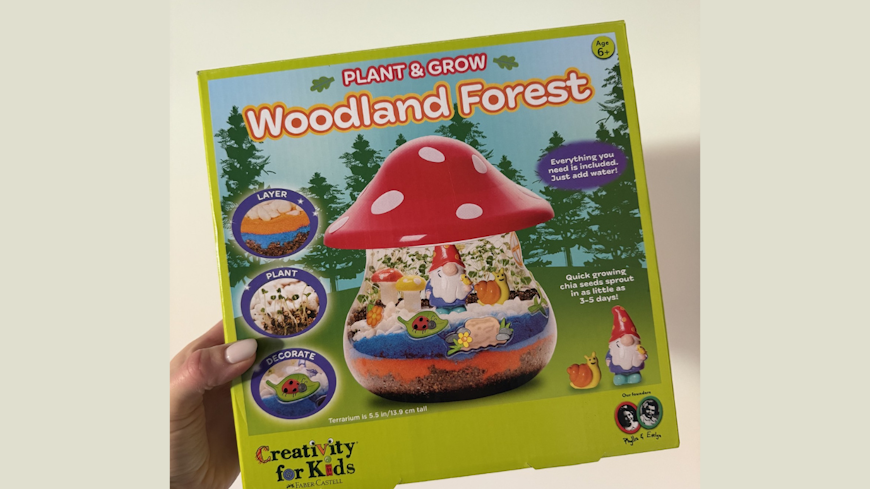
Plant & Grow Woodland Forest kit by Faber-Castell, age 6+ (item 6363000, barcode 0092633318089, box code F25138N).
The Faber-Castell product, a DIY terrarium kit, has been available through Spotlight and other online retailers. The Warehouse also sold it in November 2025.
It’s not the type of product a shopper may immediately associate with play sand, but inside the terrarium kit are two sealed bags of loose blue and orange sand.
Despite the packaging saying the terrarium kit is “Non-Toxic” and “Safe for Children”, recent testing from Auckland-based laboratory Aerem detected asbestos in the orange sand. Aerem sought further independent specialist analysis from Eurofins, a US-based company. The further testing confirmed the presence of tremolite asbestos.
The test results from Aerem and Eurofin contradict a statement, sighted by Consumer NZ, from Faber-Castell to a concerned parent. That statement said Faber-Castell’s products had been “thoroughly tested” and “do not contain any asbestos”.
Product recall initiated
Faber-Castell says it has now initiated a recall and is working with the Ministry of Business, Innovation and Employment on how to advise consumers who purchased this product.
Faber-Castell told Consumer NZ that when it became aware its product was non-compliant with NZ regulations it actively worked with retailers to remove the product from stores and to stop any further sale of the product. A check from Consumer NZ found the product was still available online on the morning of 11 November but was no longer available for purchase online by late afternoon.
Consumer NZ strongly recommends shoppers avoid all coloured play sand and watch out for craft products or toys that could contain coloured play sand this Christmas.
Need our help?
If something’s gone wrong with a product or service, our Consumer Rights Advice Line experts can help you get a fair deal.
Get personal, practical advice you can trust – included when you join from $15 a month.
Asbestos expert calls for blanket ban of coloured play sand
Ben Alford, Director of Aerem Limited, says he has zero tolerance for asbestos in children’s products and there should be a blanket ban on the sale and supply of coloured play sand.
“We have independently confirmed asbestos in the orange material tested, alongside unresolved differences between positive and negative findings for the blue material,” says Alford.
Alford explains that testing for asbestos is complicated, as a negative or positive result only applies to the portion examined. The testing can’t guarantee that every bag or batch is asbestos-free and does not cancel a positive result elsewhere. The uncertainty is why he’s calling for a blanket ban.
“The debate should not be about whether the asbestos percentage in a product is low or high. Once asbestos is confirmed in a children’s product, a lower concentration does not make its presence acceptable,” says Alford.
“Children depend on adults and suppliers to keep hazardous substances out of their toys. Families should not have to interpret conflicting laboratory reports to decide whether a product belongs in their homes.”
Consumer NZ says it is extremely disappointing that another children’s play sand product has tested positive for asbestos. The advocacy organisation continues to have concerns about the product safety protections in New Zealand – particularly when it concerns the nation’s tamariki.
Most consumers overestimate New Zealand’s product safety protections
Although it’s unfair to place the onus on consumers, the latest positive asbestos result in a children’s play product is an urgent reminder that New Zealanders can’t assume a play-sand product is safe simply because it’s sold at a legitimate retailer.
Consumer NZ research has found consumer confidence in safety is strongly influenced by where a product is purchased from. Most people are confident about the safety of products bought from a physical New Zealand store (88%) or New Zealand-based online retailer (81%).
More than a third of people think the majority of products are checked or tested for safety before being sold in New Zealand. Only 3% of New Zealanders think there is no testing or checking of products prior to sale, which has more commonly been the case.
New asbestos-testing requirements for certain products containing play sand take effect on 1 February 2027.