By Rebecca Styles
Research Lead | Hautū Rangahau
Missed bills, disconnections and going without heating – here’s what our research tells us about power affordability in New Zealand.
1. Power prices have risen at twice the rate of inflation
Since the Bradford reforms in 1999, which gave us the electricity market as we know it, household electricity costs have risen by around 177% – nearly twice the rate of inflation.
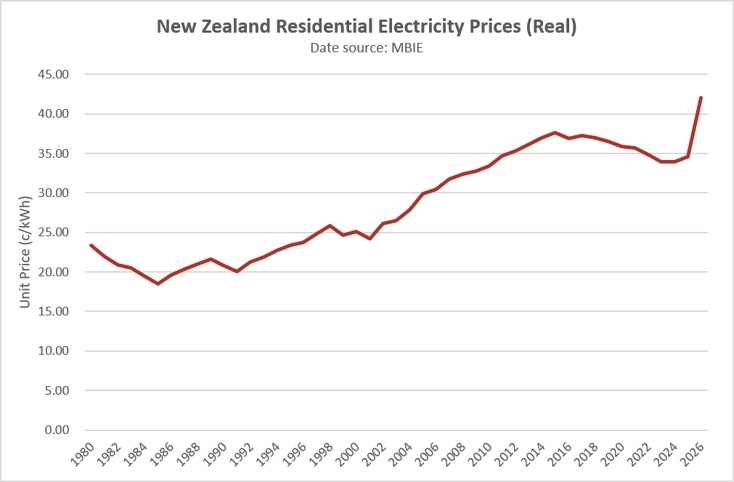
Source: MBIE, Quarterly Survey of Domestic Electricity Prices (QSDEP), May 2026.
Even when wage growth is factored in, electricity is now approximately 65% more expensive in real terms. Low-income families have been hit the hardest and are spending over 7.5% of their income on electricity.
When we compare the cost of electricity to other essentials, only buying a house has risen more.
2. People are cutting back on essentials to pay for power
Many respondents told us they managed to pay the power bills by cutting back on other essentials (32%) while 41% went without heating to save money. To reduce energy use, 21% went to bed early. All but 1% of respondents made some efforts to reduce their power consumption.
Despite these measures, 24% of people told us they’d missed paying a power bill, a 5% jump from last year.

End high power prices now
Tell the government power bills must come down. Back our four-point plan and help us fight for cheaper power.
3. It’s a growing financial concern
The cost of electricity is weighing heavily on New Zealand households. Concern about electricity costs have climbed to 48% making it the second biggest concern after groceries (70%).
Across the country, the Electricity Authority’s surveying, showed 38% of people say they aren’t confident they’ll be able to manage their power bills in the next six months.
Consumer NZ surveying has shown growing concern about power prices in higher-earning households. A third of households earning $100,000–$150,000 are very concerned about the cost of energy, as are 28% of those earning over $150,000, up 8% since 2021.
The energy hardship measures we monitor have risen modestly but consistently for higher-income groups over the past six years – between 2 and 4%. At the same time, lower-income hardship has worsened materially, between 8 and 18% across the measures.
4. More people are borrowing to pay the power bill
We’re seeing growing numbers of people borrowing money from family or friends to pay the bill, up to 19%. One in 10 respondents had taken out a loan to pay the bill.
The amount paid out in government assistance increased 5.64% in the period 2020–2025. Last year, hardship grants for bedding and blankets were up 24%, compared with 2020.
In the six years to June 2025, the government made Winter Energy Payments worth $3.6 billion.
This assistance doesn’t address the issues that created hardship in the first place.
5. 30,000 households had their power cut
When electricity becomes unaffordable, the consequences are immediate, serious and unequal. In the last financial year, more than 30,000 households had their power cut at least once because they couldn’t afford to pay their bills.
Most retailers charge both disconnection and reconnection fees, adding further pressure to households already in financial distress. These fees can be as high as $250 if you need power reconnected after hours.
Then there’s the impact on customers’ credit ratings, which has a damaging flow-on effect when it comes to navigating the electricity market. People who have a history of debt or credit issues often have trouble securing a standard electricity account (where you’re billed for your power after use).
The only remaining option is a prepay plan, and, at the time of writing, the only provider offering prepay plans is Contact Energy.
Prepay electricity customers are cut off more often, with hundreds of thousands of automatic disconnections recorded in 2025. They also have less protection under the Electricity Authority’s Consumer Care Obligations.
An electricity retailer has to carry out several steps before they cut the power to a post-pay customer, but prepay customers get just two days’ warning their credit is about to run out.
After that, disconnection is immediate. In 2025, there were 317,031 prepay disconnections in New Zealand, with some households being disconnected up to 11 times in a single month.