By Vanessa Pratley
Former Investigative Journalist | Kaipūrongo Whakatewhatewha
In November 1986, Consumer published its 244th issue, with the cover proclaiming, “Retirement villages: A new approach to caring for the elderly.”
Its cover story, “Retirement villages don’t come cheap”, went beyond a basic guide to village life. It examined the real cost of living in a village, what to look out for in village contracts and the impact of inflation on residents’ capital.

The 1986 cover of Consumer 244, featuring a retirement village resident.
On this page
I could spend all day trawling through old issues of Consumer. So much has changed, and yet some things are the same today as they were 40 years ago.
The first retirement village in Aotearoa New Zealand was opened in the ’50s in Tāmaki Makaurau Auckland. Most of the big players in today’s market, like Ryman, didn’t yet exist. At the time of our 1986 write-up, Ryman was 2 years old and operated just one village in Christchurch.
We wrote that we’d “overheard grumblings” about villages that prompted us to investigate. We’d heard rumours of:
exorbitant prices for units
financial arrangements that deprived residents of some of their invested capital
high additional fees.
Forty years later, we still hear the same complaints. Residents do pay a lot of money for a licence to occupy. Residents don’t own the unit, so they often lose out on any capital gains. When they leave, residents or their families usually pay large deferred management fees, accrued over the time of their stay. Some continue to pay weekly fees until their unit is sold, which can take months or even years. The village can hold on to the resident’s money until it’s relicensed the unit to someone else.
That’s why we’ve launched a petition calling for a mandatory three-month repayment timeframe for residents after they leave a village. It’s our latest piece of advocacy in this area, but far from our first. Here are the other ways we’ve spoken up for retirement village residents in recent years.

Peace of mind – at a price: The fitting title of a 1989 investigation into retirement villages.
2021: We called out unfair contract terms and recommended a review of retirement legislation
Consumer backed recommendations by the Retirement Commissioner to review the Retirement Villages Act and ensure better protection for residents. The review kicked off two years later (see 2023: Retirement Villages Act review begins).
Our investigation into village contracts found terms that we thought privileged village operators and risked leaving residents unfairly out of pocket.
Terms included those that:
make residents responsible for maintenance of, and repairs to, the village’s chattels, including the appliances in their unit
deny residents the opportunity to benefit from any capital gain when their occupation licence is sold, despite being required to contribute to the property’s upkeep
result in residents’ being charged penalty interest if they make any payments a few days late, while the village retains discretion to decide whether it will pay interest on money owed to residents
attempt to exempt the village from liability for damage that the village may cause to the residents’ possessions
give the village wide-ranging discretion to decide what residents can and can’t do, including whether they can have guests to stay, make improvements to their unit and raise reasonable objections to village developments.
2022: We investigated Mary’s case
Mary was an 80-year-old widow, left in financial limbo by a retirement village which still hadn’t sold her villa more than a year after she gave notice that she had to move out.
Mary said the situation had been devastating. She said when she first told the operator of her intention to move out and the circumstances behind her decision, all she got was a formal letter in her mailbox – which felt more like an eviction notice.
“I was dealing with a dying husband, I was trying to pack. I came home from the hospital and opened this letter and it was so cold, it dropped me.”
We supported calls for the Commerce Commission to investigate the use of unfair terms and their impact on residents like Mary, so that consumers would be protected. We also repeated our calls for a review of the Retirement Villages Act, which began the following year.
Mary was hopeful that by speaking out about her situation, she would inspire something to be done to protect retirees like her.
“It’s just not fair. They have all the money, all the cards in their hand, all the power. It’s got to be fairer – it’s not the way things should be at this stage of our lives,” Mary told us.
2023: Retirement Villages Act review begins
In December 2022, the Ministry of Housing and Urban Development announced it would review the Retirement Villages Act. We’ve followed the review closely, submitting at key points and reporting on the proposed amendments.
The review concluded in 2025, but an amendment bill has not yet been introduced to Parliament. Proposed changes include:
a 12-month maximum repayment timeframe will be introduced, beginning after a resident vacates their unit
operators will be required to pay interest on the funds that they owe a resident from 6 months after the resident moves out until the resident is repaid
residents will be able to apply for early access to their money (before their unit is sold) if they have a special need, such as transferring to aged residential care, or are experiencing financial hardship.
If these changes go ahead, they will apply to occupation right agreements signed 1 year or more after the amendment bill becomes law. There will be some operator exemptions from the application scheme and maximum repayment timeframe, including for villages with less than 50 units. Other operators will be able to apply for an extension if needed.
We don’t think the proposed changes go far enough, so we’re pushing for more (see Consumer’s fight for fairness).
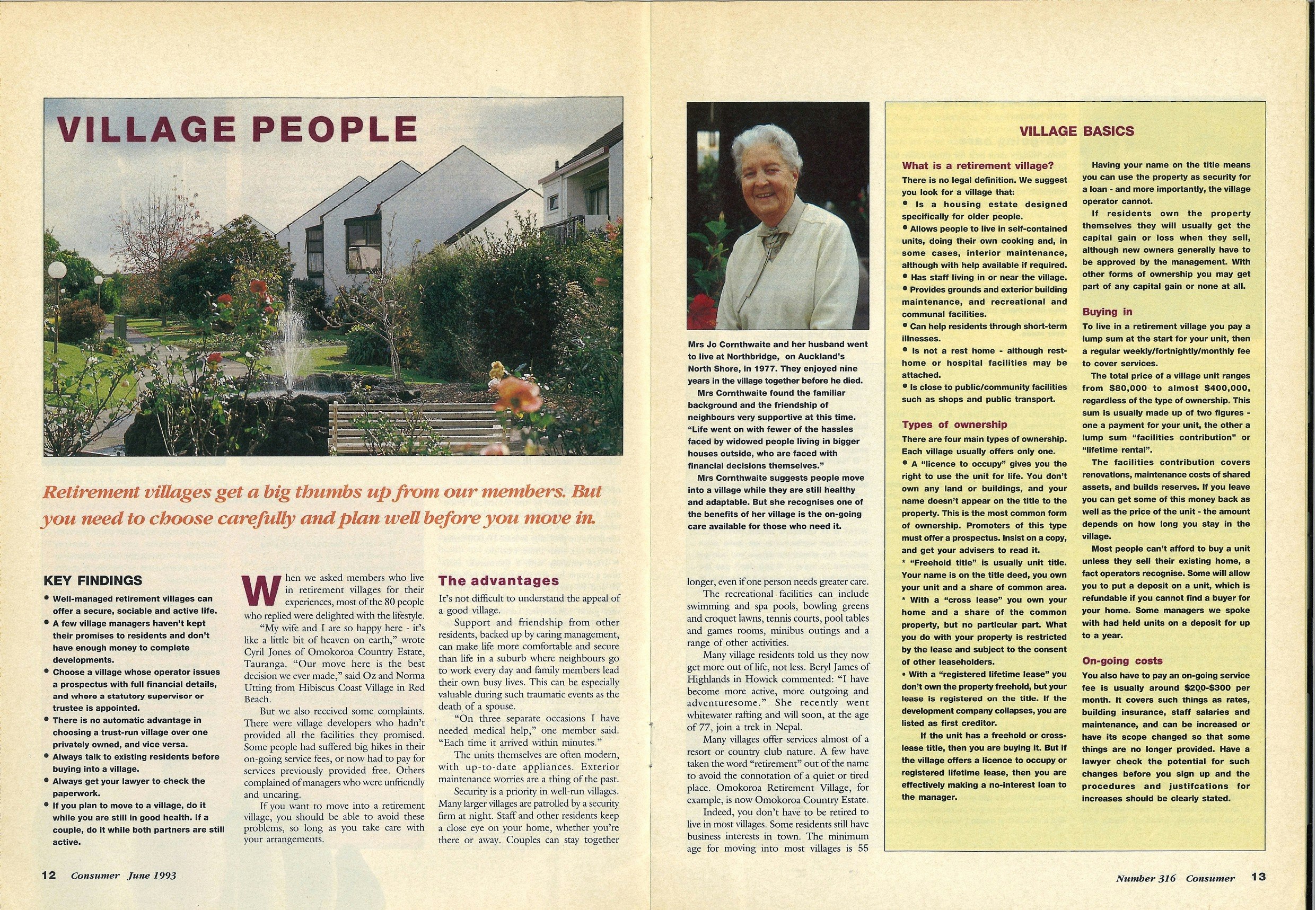
A deep dive into retirement villages we published in 1993, featuring sage advice: “You need to choose carefully and plan well before you move in.”
2025: We reported Audrey’s experience
Audrey moved to a unit in a retirement village in 2021. It was too difficult to continue taking care of her large property, and the unit was a nice place. Joanne, Audrey’s daughter, said that her mum felt part of a community there.
Audrey had to pay hundreds of thousands of dollars for an occupation right agreement (ORA), her licence to occupy the unit.
Sadly, Audrey died in July 2024. The village took over her unit to refurbish it and advertised it for sale.
Audrey’s ORA required the village to consult with her family about the marketing of her unit. But Joanne was never consulted.
“They were supposed to report back to us after 3 months. I hadn’t heard anything so emailed to see how things were going,” Joanne said.
Six months down the track, Audrey’s unit still hadn’t been sold, leaving her grieving family worrying that they may have had to continue to pay weekly fees on the property.

Petition: Fair repayment for retirement village residents
No one should be left waiting for their own money. Join our fight for fast and fair repayment within three months.
2026: We told Barbara’s story and launched our latest petition
It took Barbara’s retirement village more than 2 years to pay her back her capital after she left.
Initially, the operator wrote to Barbara every month to update her about the progress of the sale of her unit. The updates stopped coming regularly, and after 6 months, there was no valuation documentation given to Barbara, as a village must legally do.
Months passed, the village hadn’t found a new occupant, and Barbara still hadn’t received her equity back. There were no rules in place to ensure Barbara was repaid promptly.
“I had to manage treatment costs … the state of my back and my lack of balance … cerebral palsy, osteoporosis physios, not a happy state to be in. All those require regular payments,” Barbara said.
After issuing a dispute notice, Barbara finally got her money back. But she never should have had to fight so hard to get what was hers returned to her.
Consumer’s fight for fairness
We love our work and the advocacy that we do at Consumer. But we don’t want to be fighting for this simple change for decades to come.
Consumer wants new laws requiring:
full repayment of residents’ money within 3 months of the occupation right agreement ending
an interim repayment of 10% or $50,000 (whichever is higher) within 5 working days of an agreement ending
operators to pay interest on late repayments
operators to be upfront about repayment timeframes, so residents know what to expect before they move into a village.
The new rules should apply to all residents, not just future residents. Villages that face genuine financial constraints should be able to apply for extensions. Villages that share at least half of any capital gains with residents would be exempt from the repayment rules.
You can help by signing our petition.