Some Consumer NZ members have scored refunds after discovering their new car had a seatbelt fault and a low safety rating.
Suzuki’s Fronx was launched in the middle of 2025 at a competitive price of $29,990 and with the tagline “Smart. Safe. Sure!”. To date, Suzuki has sold more than 1,300 of the compact SUV in New Zealand. But later that year, this budget banger finally received its ANCAP safety rating, and the result was a shock to its owners – just a single star.
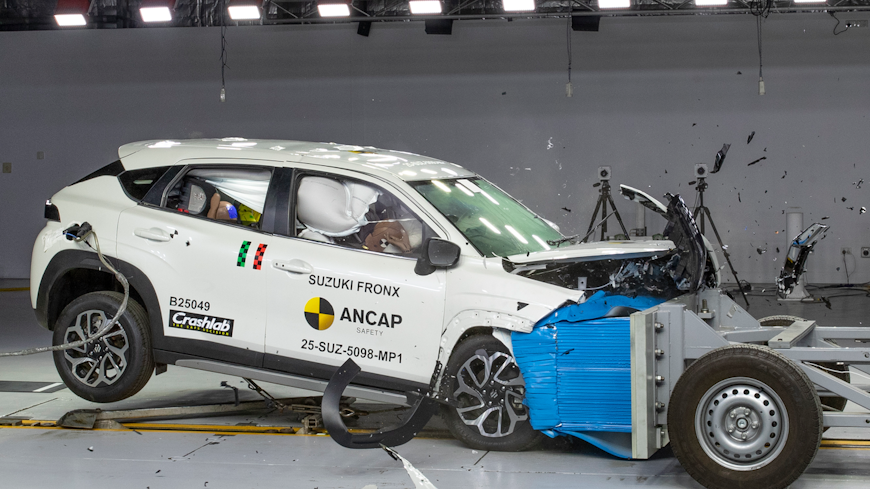
Suzuki Fronx front impact safety test. Photo from ANCAP SAFETY.
Over 80% of new vehicles tested in 2025 and 2026 received a 5-star ANCAP rating. The only 1-star rating for this period was the Suzuki Fronx.
Suzuki Fronx’s ANCAP rating
During the testing, the Fronx suffered a serious rear seatbelt failure. From the ANCAP site:
“During ANCAP’s full width frontal test, the rear passenger seatbelt retractor of the Suzuki Fronx failed, resulting in an uncontrolled seatbelt release where the rear dummy became unrestrained, allowing it to strike the rear of the front seat.”
This failure prompted Suzuki to place a stop-sale order on the Fronx for three months and recall affected vehicles to implement a fix.
However, this fix doesn’t address other issues found in the ANCAP testing – the Fronx has low levels of occupant protection in a crash for both adults and children.
Read the ANCAP alert for the Fronx.
Refunds and trade-ins for unhappy Fronx owners
Since the recall and rating announcement, a number of Consumer members have contacted us about their Fronxes.
Lee Stevenson of Blenheim told us:
“In light of the ANCAP assessment – I did not consider the Suzuki Fronx to be of acceptable quality, and didn’t feel comfortable carrying my grandchildren in the back seat.”
Another Fronx owner told us they were concerned not only about their safety in a crash but also about the vehicle’s value. “The 1 star Ancap rating outcome … just impacted the value of the car as no one will buy a brand new car if there are other cars in this category that have 4 to 5 stars.”
When the owner contacted Suzuki about her safety concerns, she was told:
“Please be assured the Fronx is a safe vehicle … This is reinforced with 4 star safety ratings for Fronx in the Japan NCAP test and 5 stars in the ASEAN NCAP testing.”
Suzuki then offered an extended 8-year warranty on the Fronx. A goodwill gesture, but it doesn’t make the vehicle any safer. The 8-year warranty is now standard on all new Fronxes, anyway.
On our advice, Lee Stevenson rejected her Fronx, citing the Consumer Guarantees Act, which states that all products must be of acceptable quality, which includes being safe. With help from the dealership, a refund was eventually secured. Lee was extremely happy with the effort put in by the dealership in her case.
Keith and Judy Girvan of Matamata, after talking to our advisor, managed to get their dealer to accept the Fronx as a trade-in. They upgraded to a safer car made by another manufacturer.
We've heard that other Fronx owners have signed non-disclosure agreements so they can't talk about the deals they’ve reached with Suzuki.
What Suzuki told us
We contacted Suzuki New Zealand to get their official line. They told us, “The Suzuki Fronx complies with all Government set safety requirements and is fit for purpose in the New Zealand marketplace.”
This is true – the Fronx does meet the minimum legal safety standards required by the New Zealand government, although this is a much lower bar than the ANCAP safety rating.
Suzuki also argued that the Fronx was not in violation of the Consumer Guarantees Act (CGA), meaning people who purchased it before the ANCAP rating was announced should not be entitled to refunds.
“There is no judicial or legislative precedent to support a rejection under the CGA based on a third-party rating. A rating is not a defect.”
We’re not so sure. The CGA says goods must be of “acceptable quality” – which includes being as “safe” as a “reasonable consumer … would regard as acceptable”. We think many consumers would expect better than one star, which ANCAP describes as “a low level of safety performance”.
Finally, Suzuki pointed out that the Fronx scored four stars in the Japanese NCAP, which is true. JNCAP and ANCAP use different test protocols and scoring systems, which can result in very different ratings for the same car.
This leaves consumers to choose which assessment they place more weight on – noting that ANCAP’s testing identified a rear seatbelt failure that didn’t arise in the earlier Japanese assessment.
More about ANCAP safety ratings
ANCAP (Australasian New Car Assessment Program) is an independent safety authority that tests new vehicles for the Australasian market.
It isn’t mandatory for vehicles to be tested by ANCAP. Suzuki started selling the Fronx last year without an ANCAP star rating, with the knowledge that by the end of the year, the vehicle would be tested and receive one. Often new vehicles will arrive on our shores like this and gain their star ratings later.
ANCAP rates vehicles based on their performance in controlled laboratory crash tests, combining this with assessment of their other safety features.
How to avoid buying a less safe car
When a manufacturer launches a new vehicle on the market, there’s usually tempting special pricing for early adopters. But if the vehicle hasn’t been reviewed or tested yet, it may pay to err on the side of caution and wait a few months. We’d also recommend signing up as a Consumer member, as you’ll then have access to our advisors, who can assist you with any post-purchase issues you may encounter.
If you own a Fronx and are concerned, then get in touch.