By Rebecca Styles
Research Lead | Hautū Rangahau
Should a highly polluting business be able to sell a product on a promise of off-setting and reaching future emission reduction goals? We look at whether Simply Milk’s claims add up, and the wider issues of confusing carbon claims.
Standing in front of the chiller trying to choose between Fonterra’s carbon net zero Simply Milk or another milk brand, you could get the impression Simply Milk was the greener choice.
The label on the bottle of Simply Milk is an image of a hand holding a tree with a bird flying by and the words “net carbon zero” in green. There’s also a certification stamp from Toitū, an independent certification scheme.
The term “net carbon zero” means a company has measured its emissions and balanced the emissions it is producing with the emissions it is removing from the atmosphere.
The use of the word “net” indicates its likely to have offset emissions by buying carbon credits which encourage environmental initiatives – like planting native trees or helping to build wind farms in other countries.
While Fonterra has measured emissions for Simply Milk, and has a plan to reduce them, we found it didn’t meet its 2024 reduction target. So, this leaves its green credentials down to offsetting by buying carbon credits. This approach has been debunked as a genuine path to reducing emissions in the long run. The focus needs to go on reducing emissions in the first place.
So, should businesses be able to sell products on a promise of offsetting and carbon reductions. And who is checking the goals are met?
We looked at a bottle of Fonterra’s carbon net zero Simply Milk to unpack the carbon claims.
Simply Milk’s carbon claims
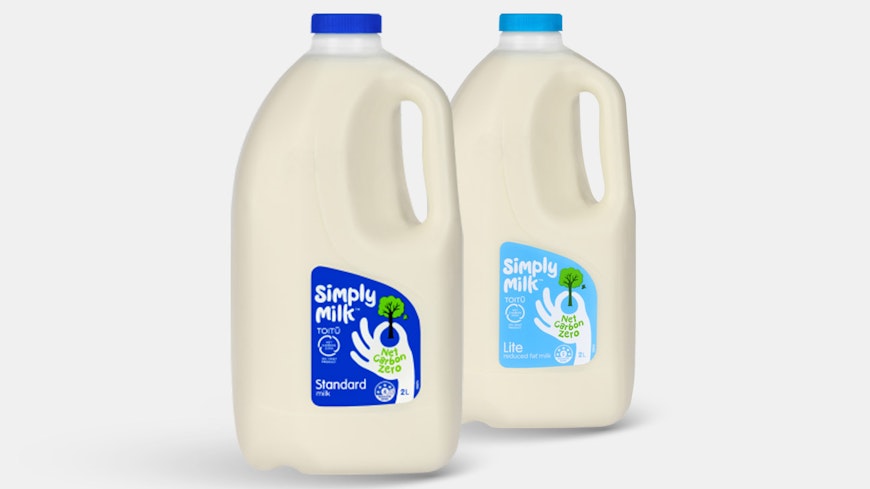
“Every time you buy Simply Milk you know you’re doing your bit to help,” it says on the back of the bottle.
What this “bit” means is the emissions calculations, projected reductions and offsets are just for Simply Milk – not for any other products made with the milk Fonterra collects from farmers.
The emission assessment is carried out by Toitū, a government-owned crown research centre which provides third-party checks for a variety of products and organisations.
Toitū has assessed Simply Milk’s emissions from the cradle to the grave (see “Carbon claims key terms” for more information on what these terms mean).
Simply Milk has an emission reduction plan that we’ll explore in the next section. As for carbon offsetting, it buys carbon credits to fund projects such as providing stoves in Bangladesh and parts of rural India, supporting wind farm initiatives overseas and investing in forest regeneration in Aotearoa.
A closer look at its carbon certification
When we took a closer look at the Toitū certification documents for Simply Milk, we noticed slight changes in wording and the numbers in the emission plans and whether specific reduction targets were set for the product, or the organisation as a whole.
Net carbon zero or carbon zero – what’s the difference?
When Simply Milk first came out in 2020 it was “carbon zero” but is now labelled as “net carbon zero” due to changes on the Toitū certification to reflect best international practice.
Carbon claims can be confusing. When we asked consumers in our latest Sentiment Tracker what they understood by the claim carbon zero, 42% thought it meant a product wasn’t producing any emissions at all, which isn’t always the case.
Carbon zero can also signal that a company cancels out the emissions that it produces (rather than not producing any). This involves measuring the amount of Co2 released into the atmosphere and investing in activities that remove the same amount of Co2, for example buying forestry credits.
The term “net carbon zero” goes a bit further in terms of what an ideal future should look like. Fonterra’s certifier, Toitū says the “net carbon zero” concept acknowledges that the goal is to reach “absolute zero greenhouse emissions” through a balance of reducing emissions and offsetting “to a future commitment to true zero”.
The new wording is meant to show what businesses are doing more clearly. Yet, going by our research on the understanding of carbon related terms, there is still work to do to make sure people understand the terms.
Has Simply Milk reduced emissions?
When Simply Milk was launched in 2020, it aimed to reduce emissions for its milk by 2.2% by 2024.
It hasn’t achieved the target. However, it is still offsetting its emissions.
“Fonterra brands NZ has not yet met the 2.2% target referred to and is unlikely to do so in 2024,” a Fonterra spokesperson said.
Even if the target had been achieved, critics have said such a small reduction isn’t enough to make a material difference to emissions. Most emissions from Simply Milk (and for other milk) come from on-farm emissions – between 81% and 85%.
We think there would have to be big changes to on-farm practices to make a material difference to reducing emissions from the production of milk.
We also noticed slight increases in total emissions for the 2-litre Simply Milk.
A spokesperson for Fonterra told us this increase was due to a “change in carbon footprint methodology and reporting and using the latest IPCC emission factors”.
They also noted that if Fonterra were to use the same calculation measure as they had previously, emissions would have reduced.
These changes were a “more accurate measure … and Fonterra will continually update its methodology to meet international best practice and the most up to date data science.”
Toitū said emissions can go up because of a range of factors including changes in production processes, farming practices and the weather.
Rather than specific emission reduction targets for Simply Milk, Fonterra now lists its company-wide reduction plans on the Toitū certification.
“Instead of targeting product specific emission reductions, Fonterra is now firmly focused on making overall reductions, both on farm and in manufacturing of all its products,” a spokesperson said.
This shift in focus illustrates the dairy giant is aiming to get emissions down across the board rather than have targets for specific products like Simply Milk.
The verdict
The language and calculation of carbon claims is evolving. That Fonterra has an independent third-party crunching the numbers to a recognised international standard is a plus.
Yet, the raft of percentages, documentation and changes in language and numbers is complicated and we think it needs to be clearer to the consumer what these claims mean.
It’s taken me hours to get to the bottom of the claims and certification. Most people wouldn’t bother. It's also reasonable for shoppers to rely on packaging claims they see in store rather than work out if they’re entirely legit.
The packaging gives the overall impression that Simply Milk is “greener” or environmentally better milk than others on the shelf.
However, it hasn’t reached its emission target, and its other milk products have similar on-farm emissions, so whether the product is greener than other milk is highly debatable.
René Dedoncker, Managing Director of Global Markets Consumer and Foodservice at Fonterra, said it is “considering its use of offsetting and net zero carbon claims on its Simply Milk range of products.”
Dedoncker added that, “Fonterra understands the greatest impact it can have on emissions reduction is to focus on its own organisational emissions – including those produced on-farm … Fonterra is now firmly focused on making overall reductions” rather than product specific reductions.
The bigger picture of dairy and emissions
The Australian Competition and Consumer Commission (ACCC) has written thorough guidance for businesses about green and sustainability claims.
It also warns that making environmental claims in highly polluting industries can be problematic. Fonterra is Aotearoa’s biggest contributor to greenhouse gas emissions, according to the latest data available.
Fonterra does report on its emissions as part of the NZ Emissions Trading Scheme, but if the Climate Change Response (Emissions Trading Scheme Agricultural Obligations) Amendment Bill passes into law, it won’t have to anymore.
The proposed law change has come about because the agricultural industry was due to start paying for its emissions as part of the Emissions Trading Scheme (ETS) from 2027. However, the National government has announced it will remove agriculture from the scheme, and instead fund research and development to help lower on-farm emissions.
However, Fonterra will report on its emissions – including those from its supply chain – as part of the mandatory climate related financial disclosure scheme.
Yet, agriculture does have the most potential for change. The ACCC says that highly polluting industries need to be “realistic and transparent about the environmental impact” of their claims.
While Fonterra could be commended for having an emission goal for Simply Milk and working towards it, whether its claims are realistic, since it didn’t reach it, is debatable. We certainly haven’t found tracing the certification documents transparent.
The question I’m left with is whether a highly polluting business should be able to sell a product on a promise of offsetting and reaching future emission reduction goals.
EU making changes to carbon claims
The European Union is clamping down on carbon related claims.
Claims about carbon will only be allowed when they are based on the actual lifecycle of the product. All green claims would need to be checked by an independent third party before hitting the shelves.
The manufacturer can’t just rely on offsetting because it can potentially mislead consumers by making them believe the offsets relate to the making of the product, when they don’t.
Companies must also prove a net-zero target, show progress towards decarbonisation and show the percentage of emissions being offset.
The proposed rule changes are set to be debated later this year.
We’d like to see more robust rules here, so carbon claims are transparent and clearly understood by people.
Carbon claims key terms
Not all carbon claims are equal. The boundaries where emissions are measured can differ from one product to another. Some claims measure the emissions for a full life cycle whereas, others stop measuring once the produce leaves the factory gate.
Other businesses measure for just one product it makes, while some have their whole organisation measured.
We’ve found it’s important to check what is being measured and its boundary so you can understand what an environmental claim really means.
Here are some key terms to help break it down.
Cradle to grave: Measures the emissions produced from extracting raw
materials and processing through to the consumer’s use and disposal
of the product.Cradle to gate: Measures the emissions produced from extracting raw
materials, processing them and distributing a product.Offsetting: When a business measures its emissions and offsets them
by supporting an environmental initiative. Critics of offsetting say
businesses should be working to reduce emissions, rather than simply
offsetting them.Scope one emissions: Emissions directly made by the company. For example, the fuel for company cars.
Scope two emissions: Indirect emissions such as the use of
electricity, heat and steam.Scope three emissions: Emissions that are not directly controlled by
the business that’s reporting on its carbon footprint. For example, a
cheese-making business that measures its emissions cannot directly
control some stages of production, such as the emissions from the
farm that supplies its milk – these supplier emissions would be
classed as scope three.
Tips for reduce your food emissions
Rather the relying on carbon claims when you’re out grocery shopping, there are other ways to reduce your emissions.
Research here and overseas has shown that a switch to more plant-based wholefoods is better for your health and the planet.
Dr Cristine Cleghorn is a senior research fellow at the department of public health at the University of Otago. Her research into sustainable nutrition and public health has shown that choosing more plant-based wholefoods can help reduce emissions and improve overall health.
Given that animal products are the highest emitters she said using alternatives to meat and dairy is a way of reducing your climate impact. Rather than reaching for highly processed animal-alternative products, she says choosing whole foods like produce, beans and lentils, is the way to go.
People don’t have to give up meat completely, she says reducing the amount we eat is a way to start.
“It doesn’t have to be black and white, having some meat free meals and reducing the portion size of the meat in your meals is a good way to start,” says Dr Cleghorn.
Dr Cleghorn says it’s not just down to individuals to make positive changes. Professor Niki Harrè, who is the head of the school of psychology at the University of Auckland, agrees.
“Shopping can be an overwhelming task, there are so many different criteria we are trying to balance at the same time,” the professor said.
She suggests you ask yourself these questions when you’re choosing products and going about your day-to-day life:
If it’s produce, is it grown in Aotearoa?
How much packaging does the product have?
Is it a plant-based food – if so, it’s likely to be kinder to the planet.
“It’s important to remember that you are just one person or family doing what you can. It isn’t up to you to change the world, but the more people who make sustainable choices, the more society as a whole starts to value practices that protect nature. Change is mostly a slow process. Don’t underestimate your small contribution as every contribution adds up.”
We’d like to see more robust rules here, so carbon claims are transparent and clearly understood by people.