By Bryan Wall
Product Test Journalist | Kaipūrongo Whakamātautau Hautaonga
If you’re in the market for a new cooktop, you’re probably not considering gas, due to the possibility of new gas connections being phased out. That makes it a toss-up between a ceramic or an induction cooktop. Externally they look very similar, so how do you choose which to buy?
What is a ceramic cooktop?
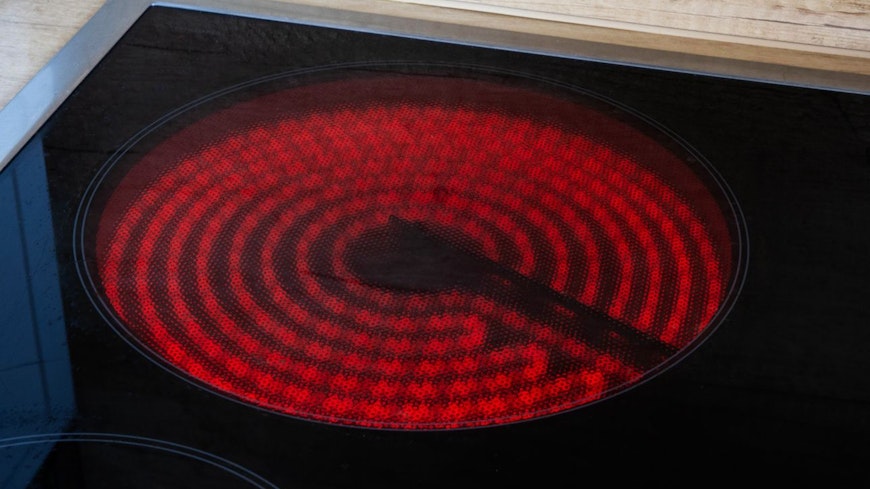
Ceramic cooktop
Sometimes known as “radiant-ceramic”, these cooktops use heating elements fixed under a glass-ceramic top to heat pots and pans via radiant heat.
What is an induction cooktop?
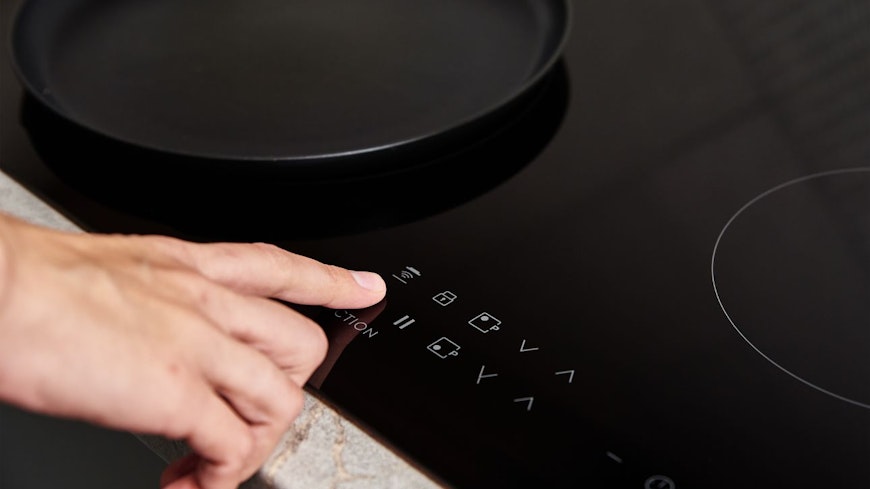
Induction cooktop
Induction cooktops also have a glass-ceramic top, but underneath are induction coils that create a high-frequency magnetic field. Cookware that is placed into this field heats up.
Which do we recommend?
If you want the best combination of cooking performance, flexibility and efficiency, then you should go with induction. But you’ll generally have to fork out more. Read on for more details.
Price
Ceramic cooktops are on average almost half the price of induction. That’s not to say you can’t get a cheap induction cooktop – we do have models in our test for less than $1,000. At the other end of the scale, we have induction cooktops that cost over $5,000, whereas our most expensive tested ceramic model is a tad over $3,000.
Performance
Our performance score for cooktops combines the scores from three tests:
making a white sauce, to test a cooktop’s ability to simmer at a low temperature for a long time
cooking rice, to test a cooktop’s “turn down” capacity and how well it maintains a suitable heat at a low setting
making a stir-fry, to test how well a cooktop delivers continuous high heat.
On average, induction cooktops are the slightly better performers. Our top-scoring ceramic model got 93, while for induction the top-performing model scored 100.
Our take from this is that, for cooking performance, both types are close enough that it doesn’t matter which you choose.
Efficiency
Efficiency tests relate to speed and energy use. For cooktops, we time how long it takes to boil a litre of water and we record the energy usage.
An induction cooktop is, on average, the fastest way to boil water, taking less than half the time of ceramic and using a third less energy. It’s also faster than an electric kettle but uses around 20% more energy.
Our fastest induction cooktop can boil a litre of water in 2 minutes and 15 seconds, while for ceramic cooktops the fastest we tested was 5 minutes 43 seconds.
Induction is also much more responsive than ceramic and performs similarly to a gas cooktop with regards to quick changes of heat.
Other considerations
Flexibility
Many induction cooktops have “flexi-zones”, where multiple zones can be joined together to create a large single zone. This allows you to cook with larger or odd-shaped pans (such as a fish kettle).
Safety
Induction cooktops are inherently safer than radiant-ceramic ones, as only the pan is heated and not the glass cooktop itself. There’s less likelihood of burning yourself on the cooktop once the pan is removed, although there will still be residual heat transferred from the pan to the cooktop, so it always pays to be careful.
Installation
Depending on the size and power rating, induction cooktops can often be more expensive to install than ceramic, as they can require 20-, 32- or even 42-amp dedicated circuits to be installed by a registered electrician.
Cookware
Ceramic cooktops will work with all your existing pots and pans, but induction cooktops require magnetisable cookware, so not all your pots and pans may work, particularly those that are copper or aluminium. You’ll also need to use the correct sized pan for the zone (typically at least 60–75% of the cooking zone diameter).