By Kate Harvey
Writer | Kaituhi
Since August 2024, supermarkets have had to display unit prices on their product price tags. We checked in with our members to see if it’s helping them save at the supermarket and found two issues that kept coming up.
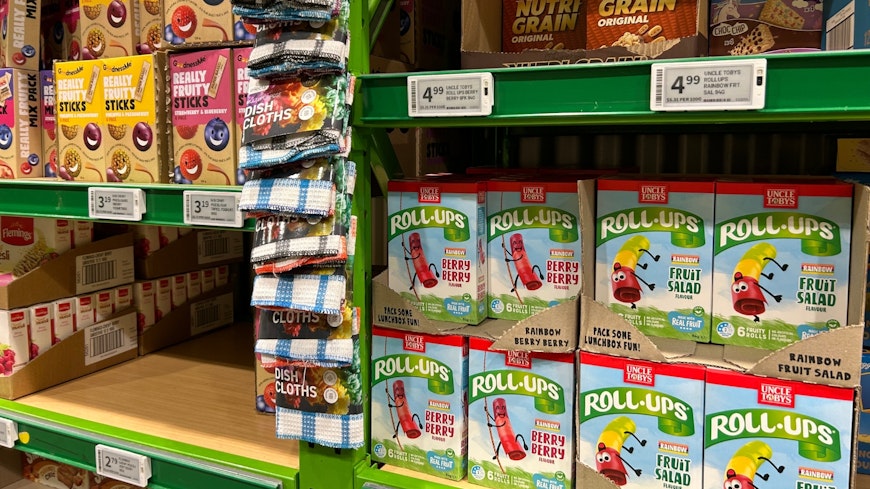
Unit prices are those smaller prices you see below the actual price – they show how much the products costs per 100g or per litre, for example. They help us block out all the distractions at the supermarket and get down to which product is really the best value.

Unit pricing – the secret to saving at the supermarket
Find out more about how to use unit pricing to save at the supermarket.
Until the regulations making unit pricing mandatory came in last year, the situation had been a bit of a mess. We’d often find unit prices missing and not calculated correctly.
So, with the first anniversary coming up, we asked our members to tell us how they think it’s going.
How unit pricing is working well for people
Most of the email replies we received praised having unit prices – after fighting for these regulations for so long, that was nice to see.
A lot of people said it had been a revelation to find that bigger sized products weren’t always better value. The benefits of having unit pricing on eggs was also something we saw mentioned a few times.
Here’s what some of those happy shoppers said:
“It makes it so easy to see if the bigger size is cheaper. The larger, although obviously more expensive, is sometimes dearer per 100g.” – Glenda
“Previously we assumed it was best to buy the bigger pack or tin. We’ve discovered that can vary from week to week and now we always check the unit price.” – Sue
“Absolutely a fan! It takes less time not having to do the maths to get the best prices, and we all know we need to count cents these days.” – Suanna
“It saves me getting out my phone calculator and typing in the numbers. It helps to protect me from package shaping, which looks bigger than it really is, shrinkflation and other tactics.” – Graham
What people aren’t liking about unit pricing
We also heard from a lot of people who are finding unit pricing difficult at times. There were two strong themes that kept coming through: the units of measure used and the legibility of the pricing.
Different units of measure for the same type of product
Our member Peter sent us a photo of Fairy dishwasher tablets, which illustrates this issue perfectly. A smaller bag of 20 tablets displays the unit price as per tablet. The bigger bag of 70 tablets has a unit price per 100 tablets.
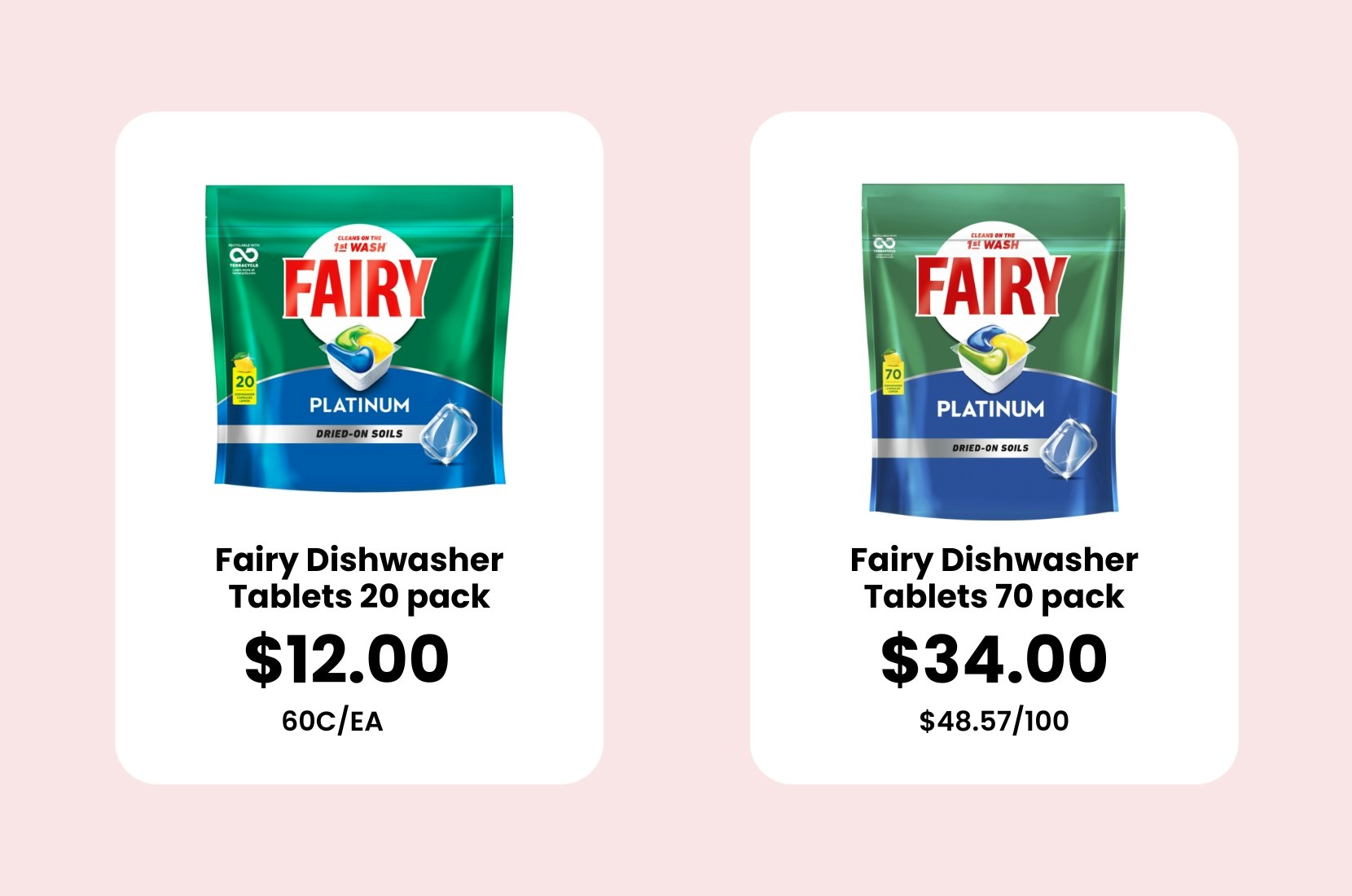
“If you have the time and a calculator handy, you can work out which is the cheapest option, but my point is that you shouldn’t have to,” said Peter.
We completely agree, Peter. The supermarkets are actually following the regulations, though. If a packet contains 40 items or fewer, the regulations state the unit price should be per item. If it has more than 40, it should be per 100 items. We raised this issue in our submission, saying the same unit of measurement should be used for all products in a category, to avoid confusion. We said the unit of measure should be chosen based on whether the majority of products in the category have more than or fewer than 40 items.
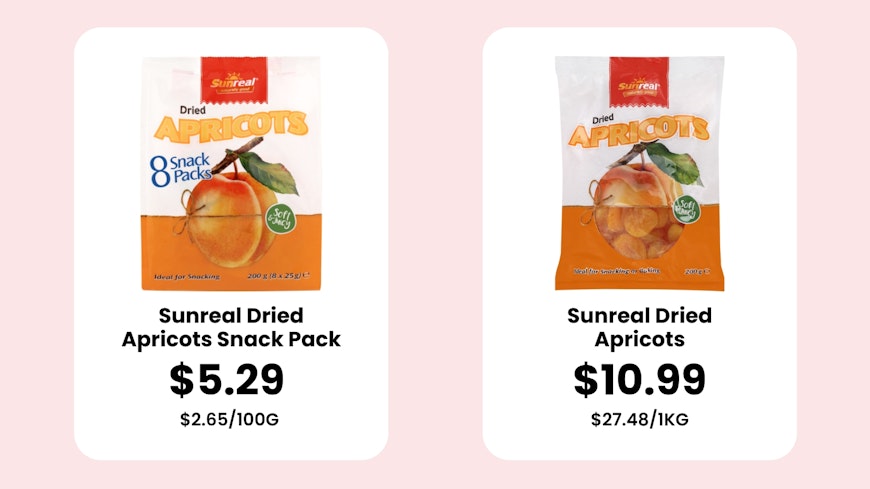
Eagle-eyed members have spotted other items that also have different units of measure though. At New World, Isabel spotted dried fruit being sold per 100g and per 1kg – the supermarket should have been using per 1kg in both instances.
Difficulty reading the unit pricing
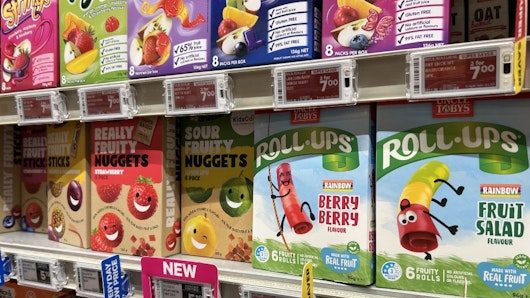
We received some humorous tales of people getting down on their hands and knees to try and read the unit prices on the lowest shelves. But even when the price tags were at eyelevel, some of our older members said they were too small to read.
“I mostly can’t read the labels, even with a magnifying glass … I like the idea but mostly it’s useless for me.” – Rosemary
“It’s a joke. The fonts used are so small I can’t read them.” – Michael
“Certainly unit pricing is a step in the right direction. Even more useful would be to display this in a size that the average human being can actually read without requiring a magnifying device.” – Gabriele
“It is often impossible to read, especially for people who wear progressive lenses.” – Janet
The regulations require the font size for the unit price to be at least 25% of the one used for the purchase price. In our submission, we said we thought it should be at least 50% of the size of the purchase price.
Where to from here for unit pricing
New Zealand is not alone in experiencing these issues around legibility and differing units of measure being used. The 441-page Supermarkets Inquiry report released in Australia in March mentioned the same issues occurring there.
Australian Prime Minister Anthony Albanese has also said his government will introduce “substantial penalties” for supermarkets that breach the Unit Pricing Code.
In the United Kingdom, changes to their Price Marking Order – which sets the rules for how unit pricing is displayed – will kick in later this year, aiming to make it easier for consumers to use unit prices.
Someone Consumer has had a lot to do with over the years is Ian Jarratt – a retired Australian economist who has spent 20 years advocating for unit pricing to be mandatory and user-friendly. Even when Australia made the move way back in 2009, he kept trying to get the same for New Zealanders.
Ian says we can all help improve how well unit pricing works by letting supermarkets know when we spot issues. “If supermarkets know we’re watching, they’ll be more likely to stick to the rules. And if you repeatedly notice issues you should complain to your Commerce Commission.”
We’ll be writing more on unit pricing throughout the year and you may be invited to take part in a survey we’re conducting on the topic. If you see any examples of unit pricing that are not helpful, please send an email to [email protected].
8 ways to save with unit pricing at the supermarket
Unit pricing expert Ian Jarratt has shared his tips for cutting the grocery bill.