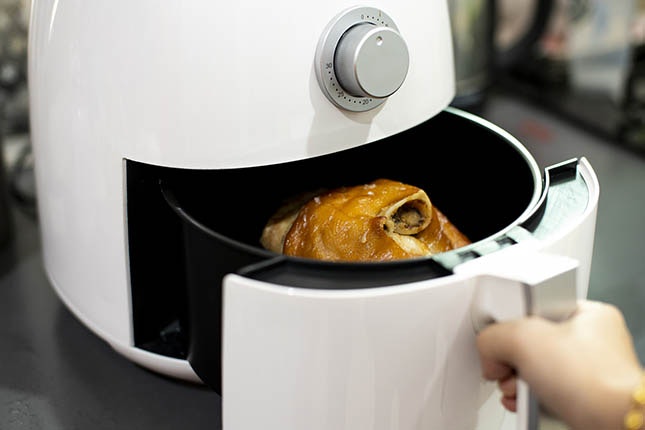
Air fryers surround food with hot air so you can cook with little or no oil. The result should be food that’s crisp on the outside without the added kilojoules of deep-frying. We put air fryers to the test cooking thick-cut fries and crumbed chicken.
On this page
Lifetime score
Our overall score combines test performance (how well the appliance works) with predicted reliability (how likely models from the brand are to remain free of faults) and brand satisfaction (how likely owners of the brand are to be very satisfied).

We’ll only recommend appliances you’ll love to own, that work well and keep working well for a long time.
Test performance
It’s no good if a product lasts for several decades if it doesn’t work well in the first place. A disappointing product will soon become unloved and unwanted. For this reason, our independent lab testing still forms an important part of our overall lifetime score.
Our test performance score is comprised of two sub scores:
Performance: Weighted equally on crumbed chicken breast nuggets and thick-cut frozen chips. We also test new models on chicken wings and roast pork. These tests weren’t conducted on previously tested models so don’t contribute to our performance or overall scores.
Ease of use: Assesses how easy it is to assemble and use the controls. This includes how helpful the instructions are. We also consider how easy it is to clean and store the cooker away after use.
If a model is also a benchtop oven we perform 3 additional tests: roasting a whole chicken, cooking a pizza and grilling toast. These tests do not contribute to the overall score, but are useful if you are considering a model for the roasting and grilling functions.
Running costs calculated on 30 minutes’ use 3 times a week (electricity costs of 25¢/kWh).
Predicted reliability
It’s reasonable to expect a new appliance to remain fault-free for at least the first five years. Our predicted reliability won’t tell you when your air fryer might stop frying, but it does show which brands make models that are less likely to fail.
Brand satisfaction
Satisfaction is important – no appliance should be a source of buyer-regret. Appliances with very satisfied owners are more likely to get cleaned regularly and maintained well. Their owners are more likely to seek repair for faults than look for a quick replacement.
Repairability (coming soon)
Older appliances are more likely to go wrong, but common faults should be repairable. Repairs should be affordable and convenient – parts need to be easy to find at a reasonable cost, instructions should be available, and repair shouldn’t need hours of expert labour.
We haven’t been able to assess repairability yet, but it’s important, so we’re gathering data and forming a plan so we can start including it in our lifetime scores. It will be challenging. We’ll need to analyse product failure data in our reliability surveys, conduct hands-on inspections to evaluate how easy products are to take apart, and investigate which brands make spare parts available at a reasonable price.
Survey data 101
In our annual reliability and satisfaction survey, consumers tell us about faults that have left an appliance they own unusable or mean they’ve had to change how they use it. We also ask them how satisfied they are with the appliance. We use their data to produce our predicted reliability and brand satisfaction scores.
We use a statistical test to rate the relative performance of each brand. Compared to data we have for all products (of the same type) in the survey, we rate each brand with highest, high, average, low or lowest reliability and satisfaction. You can compare the rating of different brands for the same product type (for example, the reliability rating for Miele and Haier washing machines), but you can’t compare the results for different product types (for example, satisfaction of LG TVs and Samsung phones).
We analyse brands that get at least 30 responses in our survey. That means there are some brands we can’t analyse because we don’t have enough data. For those brands, we assume they have average predicted reliability and brand satisfaction.
Our data is based on responses for 3576 air fryers in our 2025 survey.