By Rebecca Styles
Research Lead | Hautū Rangahau
We tracked the prices of 16 items Ted regularly bought at his local supermarket between February 2020 and May 2022. What do these receipts tell us about the cost of food?
Ted sent a pile of his supermarket receipts to the Consumer NZ office.
“I just heard you were doing some checks on the supermarkets, so I thought I’d send them in,” he said when I called him up to thank him.
Prices are “just going from worse to worse,” he added.
It’s been a tough few years for Ted. In March 2020, just before the nationwide Covid-19 lockdown, he retired and moved in to look after his mother, who had late-stage dementia. Unfortunately, she passed away during the lockdown.
Now, Ted’s on the waitlist for a hip operation, so he’s not as mobile as he wants to be. He had his knees done a few years ago and was walking at least three kilometres a day, but his hip trouble has put a stop to that.
On top of these worries is the price of groceries.
Ted gets on well with the people at his local supermarket – a New World in the lower North Island – so, we’ve used a pseudonym for this story.
We’re grateful Ted thought to send us his receipts. They paint a real-life picture of how prices have fluctuated, and for the most part gone up, over the past few years.
We found carrots and kumara went up in price (95% and 101% respectively), while a tin of apricots went up 79%. Anchor ready-made custard also went up (55%), as did bread, jam and biscuits. Only budget-range butter went down.
The cost of fresh produce
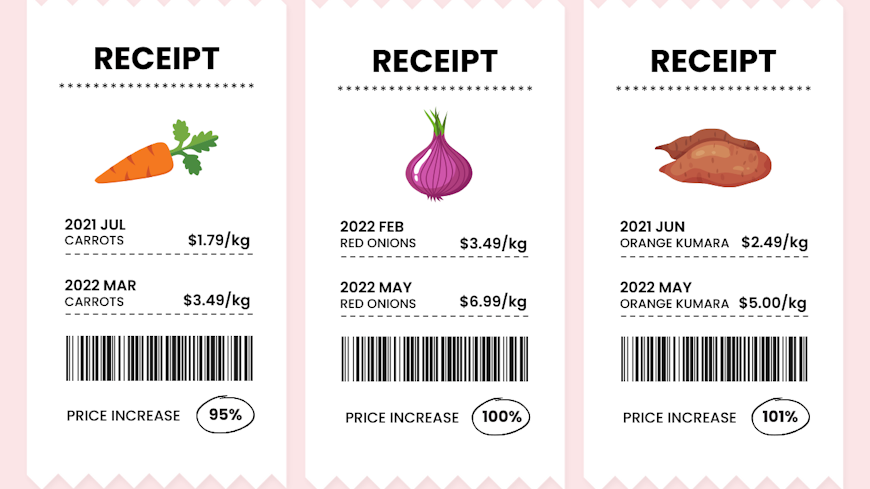
Back in July 2021 you could buy a kilogram of carrots for $1.79 but the price jumped to $3.49 in March 2022. A 95% increase.
The price of red onions doubled between February and May 2022 from $3.49/kg up to $6.99/kg.
The cheapest orange kumara Ted bought was in June 2021 when it was $2.49/kg. In May the following year it was $5.00/kg. Today, it’s at its most expensive – $13.49/kg. That’s a 442% increase.
The cost of milk and butter
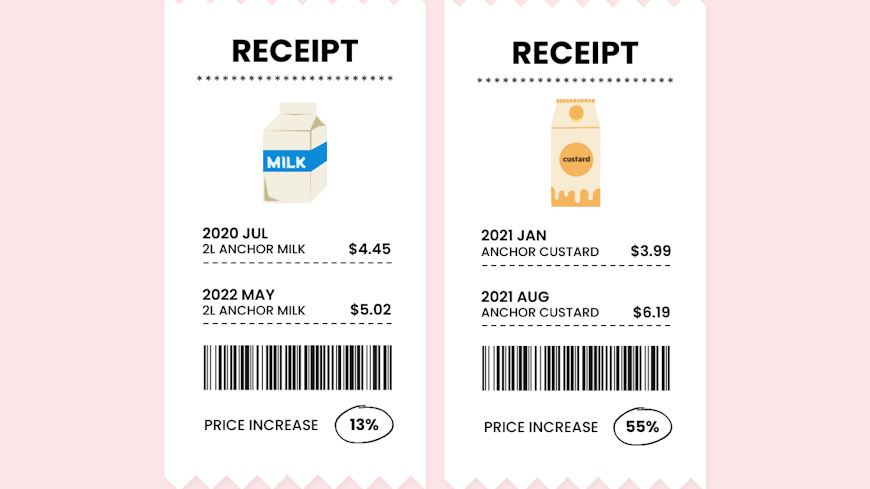
A 2L bottle of Anchor lite blue milk was the cheapest in July 2020 at $4.45, but by May 2022 it climbed to $5.02. Last month it was $5.10.
A 1L bottle of the same brand was $2.82 on November 2020, but climbed to $2.97 eight months later.
A 500gm block of Anchor butter was at its most expensive in March 2020 at $6.89 and dropped to $5.89 in December 2021. That’s good, but when we looked online this month, it’s up again to $8.49. That’s a 44% increase from when it was at its cheapest.
Pams 500gm butter was at its cheapest in early 2020 too, at $5.39. But the budget brand climbed to $6.99 in May last year. Now, it’s at an “everyday low price” of $4.99. One of the few products to drop in price.
Anchor Vanilla Custard (1kg) fluctuated in price, too. It was cheap in January 2021 at $3.99, but it was up to $6.19 eight months later. A 55% increase.
Price increases in the grocery aisles
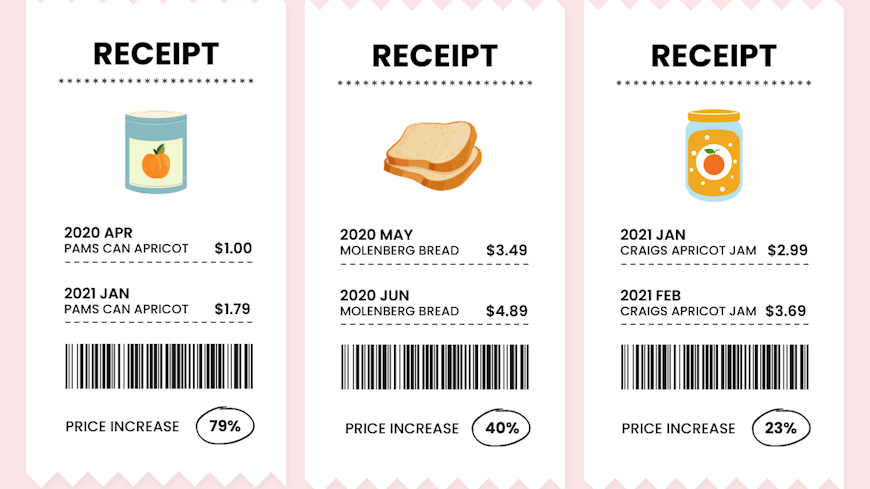
Based on Ted’s receipts, the biggest price increase along the grocery aisles was for a can of Pams Apricot Halves in Syrup (410gm). You could get a can for $1 in April 2020. At its most expensive it was $1.79, before going down a bit in price to $1.29.
Bread had a big price increase, too. Two loaves of Molenberg bread (sandwich and toast; both 700gm) cost $3.49 each in May 2020, rising to $4.89 each the following month – a 40% jump. Last month, a loaf was $3.99.
The cost of Nature’s Fresh Multigrain (700gm) was stable from October 2020 to February 2022 at $2.99, before going up to $3.29 the following month.
Ted bought some Craigs Apricot Jam (375g) to put on his toast for $2.99 in January 2021, but the following month it was $3.69. When we looked online to see how much it is now, it had jumped to $4.49. A 50% increase from when it was at its cheapest.
Sweet treats more expensive
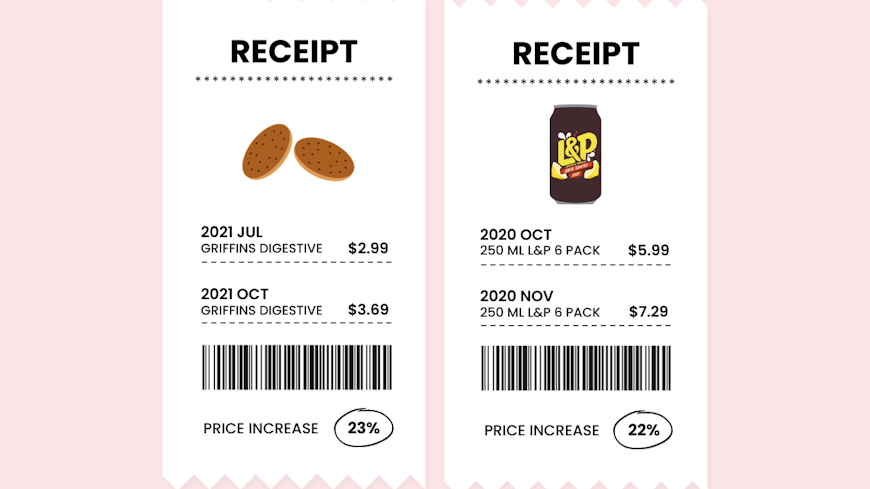
If you wanted a sweet treat and reached for a pack of Griffins Digestive biscuits (250gm) it would set you back $2.99 in July 2021. That was up to $3.69 four months later.
And if you wanted a can of the Kiwi classic L&P, a 250ml six pack was $5.99 in October 2020, but up to $7.29 the following month. Now, a pack is up to $8.49.
It’s getting more expensive to meet basic nutritional needs
Any of us that go regularly to the supermarket know prices have been rising for the past few years. This has been backed up with Stats NZ data.
Ted’s receipts give an insight into the price rises of individual items. An 5% increase here and 40% rise there don’t take long to add up to a whopping grocery bill. The only product that reduced in price, among the products we monitored through Ted’s receipts, was Pams 500gm butter.
Earlier this year, the Department of Human Nutrition at the University of Otago released its 2023 estimated food costs survey. It showed that the weekly food costs for a basic diet for a family of four has increased 24% compared to 2021 – meaning a family would need to spend $273 per week to meet their basic nutritional needs.
The increase in cost was due to large increases “in the cost of nearly all foods and large increases in vegetables, dairy foods, eggs, potatoes and meat,” the study’s authors said.
Reflecting this, the cost of groceries is the top concern for people we survey for our quarterly Sentiment Tracker. It’s also no surprise that trust in supermarkets has dwindled. Only 17% of the respondents in our latest survey had a high level of trust in supermarkets.
We’re calling for more changes to the supermarket duopoly
While inroads have been made to challenge the supermarket duopoly (Foodstuffs and Woolworths), change is slow going, and most consumers aren’t seeing a difference at the till yet. Shoppers deserve fair prices at the supermarket and we're not confident that's happening right now.
We’re still calling for:
supermarkets to stop offering price discounts only to their loyalty card holders
regular monitoring of retail prices and margins
increased Fair Trading Act penalties for misleading pricing
collective bargaining by suppliers to be allowed.
Make supermarkets price it right
Find out about our campaign to tell the government we need clear rules, stronger penalties and automatic compensation for shoppers.