By Ruairi O'Shea
Former Investigative Writer | Kaituhi Mātoro
When it comes to competition, the supermarket sector has seen no meaningful improvement. This announcement, made by the Grocery Commissioner Pierre van Heerden today, comes just over 2 years after the release of the Commerce Commission’s grocery sector market study in March 2022.
On this page
- Growing supermarket profit margins a ‘red flag’
- Grocery Supply Code review brought forward to tackle power imbalance
- Pricing inaccuracies must be fixed
- No challenger means high levels of profit and market share continue
- Significant barriers to entry for challengers remain
- Land banking of more than 100 properties reduces site availability
- Change will take time
- Consumer’s view
Since nothing much has changed at the till, what can consumers expect moving forward? We break down the key takeaways from the first annual grocery report.

Growing supermarket profit margins a ‘red flag’
The Commission reports that from 2019 to 2023, retail margins at New World, Pak’nSave and Woolworths have increased by 3.1% across non-fresh product categories and 0.4% on fresh product categories.
A retail margin is the difference between what a retailer buys the product for, and what it sells it for.
The supermarkets point to supply cost increases and power imbalances with large suppliers as the reason for price rises, but the Commission is not buying it. Its analysis shows that the supermarkets’ retail prices have been increasing faster than the prices they pay to their suppliers.
Van Heerden says that this is a “red flag for the state of competition in the grocery industry in New Zealand”.
Grocery Supply Code review brought forward to tackle power imbalance
The Grocery Supply Code was introduced in September 2023 to address the power imbalance between the supermarkets and their suppliers.
The penalties for breaching the code can be significant: a maximum fine of $3 million, the value of the commercial gain, or three percent of turnover, whichever is highest.
However, despite the introduction of the Grocery Supply Code, the Commission reports that many suppliers remain fearful of retailers, and that reports of bullying behaviour continue.
As a result, the Commission has brought forward its first review of the code.
Pricing inaccuracies must be fixed
Van Heerden says that “consumers are being ripped off by large millions of dollars each year” due to misleading and inaccurate prices.
The Commission writes that the “continuing level of pricing errors happening across the major supermarkets is unacceptable”, and that not enough is being done to fix these problems.
Following Consumer NZ’s complaint about dodgy specials, the Commission has started investigations under the Fair Trading Act into the major grocery retailers, focusing on false and misleading pricing claims in supermarkets. At the same time, the Grocery Commissioner will be introducing a mandatory Disclosure Standard that will require the major supermarkets to regularly disclose information about customer complaints and resolutions, including around pricing and promotional issues.
In the report, the Commission references Woolworths’ policy that if a customer is charged the wrong price, they will be refunded, and they can keep the product. Foodstuffs’ policy is to refund the difference, which the Commission states is “not much of an incentive for consumers to check their receipts”.
Speaking in August, van Heerden said, "They charge the wrong price and you get it for free. That should just be standard."
While we agree that customers should be refunded if they are charged incorrectly at the supermarket, we believe that it should not fall to a consumer to investigate price inaccuracies, but to the Commission.
No challenger means high levels of profit and market share continue
No significant challenger to the supermarket duopoly has emerged, meaning that the major retailers continue to hold an overwhelming proportion of the grocery market share. In 2019, the major supermarkets accounted for 83% of the market. Four years later that figure is 82%.
While the Commission has not seen meaningful change in competition nationally, in Auckland, where Costco has entered the market and The Warehouse has expanded its grocery offer, market share of the major retailers has fallen from 74% in 2022 to 70% in 2023.
Significant barriers to entry for challengers remain
Despite legislative and regulatory changes that have been put in place to improve access both to groceries at wholesale prices and sites for the development of retail stores, New Zealand’s grocery industry remains a challenging industry to get a foothold in.
The Commission reports that New Zealand’s small, widely spread population means there are limited locations with concentrated consumer demand in which a new entrant can operate profitably, while new entrants also have the brand recognition of the major players to contend with.
And while the Grocery Industry Competition Act 2023 requires the major retailers to establish competitive wholesale offers, this has had little impact on the market.

Land banking of more than 100 properties reduces site availability
Significant steps have been made to remove anti-competitive covenants which have stopped rivals from challenging each other in local markets, with Foodstuffs successfully prosecuted and fined $3.25 million for deliberately blocking competitors. However, land banking remains a significant issue.
The Commission reports that the major retailers currently hold more than 100 properties which are not being used for retail stores, and that this could be a “significant and material factor reducing the number of sites available to retailers looking to enter or expand in the market”.
The Grocery Commissioner has asked the supermarkets for more information on the properties they hold and intends to investigate the issue of land banking in the coming year.
Change will take time
Clearly there are significant issues within New Zealand’s grocery sector. The Commission believes that three major national supermarket networks would be significantly more competitive than two, and that this is achievable in New Zealand. However, in its report it also says that addressing these problems will take time and that meaningful improvement is years away.
“Even if a significant challenger were to emerge tomorrow, it would take some time for them to establish themselves and grow market share. Major third entrants to grocery markets in Australia and Finland took over a decade to reach 10% market share,” the Commission says in its report.
Consumer’s view
Consumer applauds the Grocery Commissioner’s first annual grocery report, which provides much needed transparency on the concerning state of the supermarket sector.
“It’s been 2 years since the grocery market study, and the Commission’s report highlights there has been no meaningful improvement in competition in the sector. For retail margins to have increased speaks to the audacity of our duopoly – despite declining public trust and increased regulatory pressure, it continues to squeeze suppliers and increase its margins at the checkout,” says Gemma Rasmussen, head of research and advocacy at Consumer.
“We agree with the Commissioner that the time for talk is over. His analysis of the 2 years since the market study clearly shows that the supermarkets won’t move unless they’re pushed. It is time for action by the Commission and the government.”
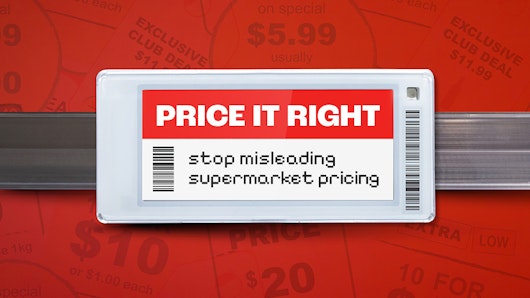
Make supermarkets price it right
Find out about our campaign to tell the government we need clear rules, stronger penalties and automatic compensation for shoppers.