By Jessica Walker
Communications and Campaigns Manager | Pou Whakahaere Whitiwhiti Kōrero, Kaupapa Whakatairanga
Each year, Consumer NZ surveys everyday New Zealanders to find out how they are faring with their power provision.
We ask general questions about satisfaction with power providers and dig into whether people can afford to keep their homes warm enough, whether they’ve been struggling to pay their bills and whether they’ve ever been disconnected because they couldn’t afford to pay. The results last year were grim, and this year, they are even worse.
The most common energy-saving action is to switch off the lights when leaving a room, something nine out of ten of us do. But, while most New Zealanders are taking steps to reduce their power usage, their reasons for doing so vary.
For those with the financial means, reducing power usage takes the form of equipping themselves with energy efficient appliances or a solar-powered lifestyle to lower their carbon footprint. However, for other New Zealanders, reducing power usage is not a choice – it’s a financial necessity. One in ten New Zealanders are living in a home that is not as warm as they would like because they have cut back on heating to save on energy costs.
Escalating concerns about energy costs
We keep a close eye on how people feel about the cost of energy; we track it every three months.
In July 2025, almost half the people surveyed ranked energy costs among their top three financial concerns.
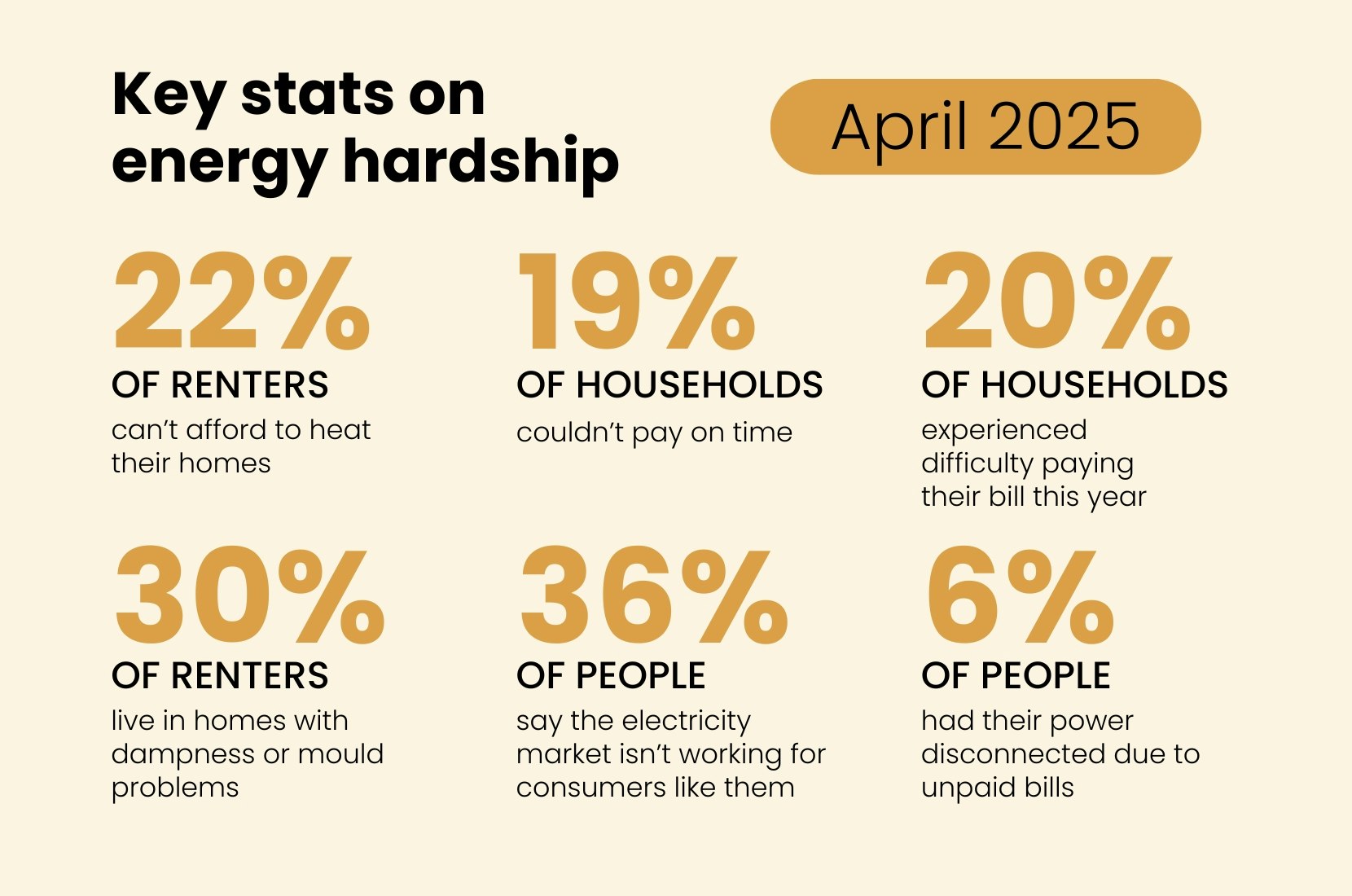
This year’s energy retail survey revealed that 56% of respondents were concerned about the cost of their household energy, and in the last year, 20% experienced difficulty paying a power bill.
Managing payment problems
More people missed a payment deadline this year than last. People who can’t pay their bills on time often go on to face additional costs. In the past year, 15% said they’d had to pay overdue fees.
Family and friends have come to the rescue for 14% of New Zealanders, by lending their loved ones money to pay their power bill. However, not everyone has someone to lean on for financial help: 7% said they had to take out a loan to cover the power bill. And one in 10 sought government assistance to keep the lights on.
It’s no surprise that just over one-third of New Zealanders think the electricity market is working poorly for consumers like them.
A light at the end of the tunnel?
The Electricity Authority developed the consumer care obligations (CCOs), which came into force on 1 April this year.
Under the CCOs, if your power provider knows you are struggling to pay for power it must help you manage your power use and costs. So, the best thing someone can do if they’re struggling to pay their electricity bill is let their provider know.
If you ask your provider whether there’s a more suitable plan for you, the provider must tell you the options.
Disconnection should be a last resort
The CCOs are clear: before disconnection, an electricity provider must try and contact the customer at least five times. If a provider decides it is going to disconnect a customer, it should do so at a time when it’s easy for the customer to get reconnected. This means disconnection should not happen just before a weekend or public holiday, or late at night.
If a customer or someone in their household is medically dependent on electricity, their provider must not disconnect them.
However, it is up to the customer to let the provider know about the medical dependency, and the provider must help that customer register as a medically dependent consumer.
Although a provider cannot disconnect a household if someone is registered as, or applying to be registered as, a medically dependent consumer, the provider can’t guarantee electricity outages won’t happen.
The dawn of the CCOs is something to celebrate. Many advocacy groups, including us, campaigned hard for better protection for those struggling to pay their power bills.
Sadly, there is a subset of consumers who are still not getting the protection they deserve.
The perils of prepay
Post-pay customers generally pay for power once they’ve used it. Prepay customers pay in advance, and once their credit runs out, the power goes off.
Some people like using prepay because it helps them manage their budget. Others have no choice but to use it because their credit history means they can’t find an electricity provider that will take them on as a post-pay customer.
Our findings indicate that 8% of New Zealanders have been denied as a customer by an electricity provider because of previously missed payments. Under the CCOs, if a provider turns down a customer, they must tell that customer why and give them information about where they can go to compare power providers and plans.
While that sounds like progress, under the current regime, some people with a bad credit rating or poor payment history still have no choice other than prepay. According to our latest survey, 5% of New Zealanders have had to switch to a prepay plan because of trouble paying their bills.
Regardless of the CCOs, people on prepay still have no protection against disconnection – their power will run out with their credit.
15% of people currently on prepay told us they’d been disconnected because they didn't have enough money to top up. The figure represents a significant number of people in the dark, feeling cold, with no power to change their circumstances and is a stark reminder of how fragile access to energy can be for those doing it toughest.
What can we do?
If you know someone who’s struggling to pay their bills, encourage them to tell their power provider, the CCOs will give them greater protection than they had before.
At Consumer, we have started to think about access to electricity as a human right. We are exploring what that concept would mean for New Zealanders.
As a nation, we can’t continue to ignore the perils of people stuck on prepay power. Such power poverty cannot persist. It’s time for change.
Are you paying too much for power?
We'll help you compare and find the best electricity and gas plan. Check now to see if you’re getting the best deal.